

JETTISON Aquatic Algaecide and Herbicide - Endothall


Description
Jettison™ Aquatic Herbicide & Algaecide | A Hydrothol 191 Alternative
A simpler way to treat lake and pond weeds and algae. Jettison comes in pre-measured 5 oz. water-soluble packets, sometimes called WSPs, so there is less measuring, less handling, and no loose product to portion out for each application.
Jettison™ is a Group 31 contact herbicide and algaecide formulated with 69.1% Mono(N,N-dimethylalkylamine) salt of Endothall. It controls certain algae and submerged aquatic plants in approved quiescent, slow-moving, and flowing water sites.
If you have used Hydrothol 191 Granular, Jettison provides an easier-to-handle water-soluble packet format within the same endothall active-ingredient family. It is a different formulation and concentration, so it is not a 1:1 rate replacement. Always calculate the Jettison rate from the Jettison label.
Instead of measuring liquid concentrate or portioning loose granular product, calculate the number of whole packets needed and distribute the unopened packets directly into the treatment area. The packets dissolve in the water and release the concentrated gel beads into the water column.
- Pre-measured 5 oz. water-soluble packets simplify measuring and application.
- No opening, cutting, or measuring partial packets.
- Functions as both an aquatic herbicide and algaecide for labeled targets.
- Controls certain planktonic, filamentous, and branched algae.
- Controls several submerged aquatic weeds, including Hydrilla, Milfoil, Coontail, Naiad, and Pondweeds.
- Package contains four 5 oz. water-soluble packets.
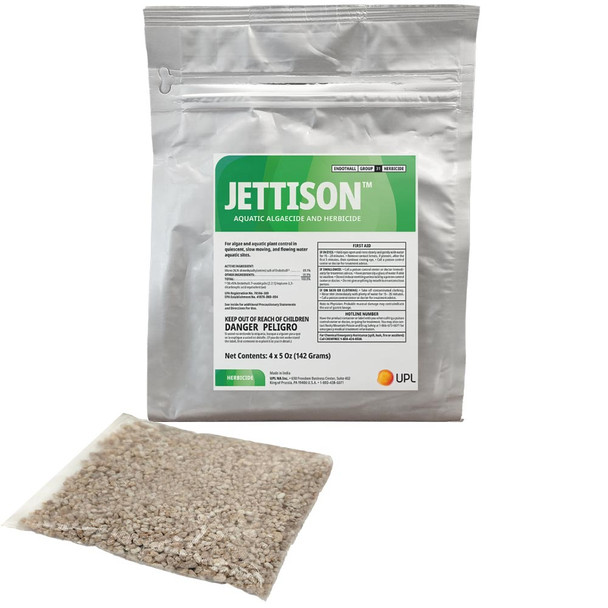
Pre-Measured Water-Soluble Packets Simplify Lake & Pond Treatment
Jettison packages concentrated gel beads inside pre-measured water-soluble packets. For the labeled drop application method, you calculate the number of whole packets needed, keep them sealed, and distribute them into the treatment area. This eliminates the need to measure an individual liquid dose or portion loose granular product for each packet application.
Pre-Measured 5 oz. Packets
Each packet already contains 5 oz. of Jettison, making treatment planning easier once you calculate the required number of whole packets.
No Liquid Measuring
For the drop application method, there is no individual liquid dose to pour or measure before each packet is placed into the water.
No Loose Granules to Portion
Whole packets stay sealed until application, helping simplify handling compared with measuring and broadcasting loose product.
Drop, Dissolve & Treat
Distribute unopened packets throughout the calculated treatment area. The water-soluble packet dissolves and releases the concentrated gel beads into the water column.
Hydrothol 191 Alternative
Jettison is an endothall-based alternative for customers comparing Hydrothol 191 and looking for an easier water-soluble packet format.
Herbicide + Algaecide
One labeled aquatic herbicide and algaecide controls multiple algae groups and several submerged aquatic weed species.
Looking for Hydrothol 191? Jettison Offers an Easier Water-Soluble Packet Format
For customers searching for a Hydrothol 191 replacement, Jettison is a practical endothall-based alternative that simplifies application with pre-measured water-soluble packets. Hydrothol 191 and Jettison are different formulations, so application rates are not interchangeable.
What is the difference between Jettison and Hydrothol 191?
Hydrothol 191 is a endothall formulation. Jettison uses concentrated gel beads sealed inside pre-measured water-soluble packets. For the Jettison drop application method, you calculate whole packets instead of measuring an individual dose.
Can Jettison replace Hydrothol 191 Granular?
Jettison can be a practical alternative for many labeled algae and submerged weed treatment situations where customers previously considered Hydrothol 191 Granular. Always match the target species, site, water depth, and rate to the Jettison label.
Is Jettison a herbicide or an algaecide?
Both. Jettison is an aquatic herbicide and algaecide labeled for certain submerged aquatic weeds and algae in approved aquatic sites.
What if I searched “Hydrothol 191 granual”?
If you searched hydrothol 191 granual, you are likely looking for Hydrothol 191, Jettison is an alternative endothall formulation that uses pre-measured water-soluble packets instead of loose granular product.
Why are water-soluble packets easier to use?
The water-soluble packets are pre-measured. You calculate the number of whole packets required, keep them sealed, and distribute them into the treatment area. There is no partial-packet measuring and no need to open a packet before application.
Is Jettison the same as Aquacide?
No. Aquacide is a separate product and brand name used in aquatic weed control. Jettison is specifically an endothall-based aquatic herbicide and algaecide packaged in water-soluble packets.
Easy Packet Application for Active Algae and Weeds
Jettison is a contact algaecide and herbicide packaged in water-soluble packets. Once you calculate the correct number of whole packets for the treatment area, application is straightforward: distribute the sealed packets according to the label and allow them to dissolve in the water column.
Treatment performance varies based on the target species, subspecies, local strain, water temperature, water depth, infestation level, water movement, and other site conditions.
- Determine the treatment area and average water depth.
- Select the labeled ppm rate for the target algae or plant.
- Calculate the required number of whole water-soluble packets.
- Distribute packets evenly throughout the designated treatment area.
How to Apply Jettison
Apply Jettison as evenly as possible within the predetermined treatment area. Keep all water-soluble packets sealed until they are placed into the water.
Measure
Determine the treatment area and water volume based on surface area and average depth.
Calculate
Use the product label and target ppm rate to calculate the number of whole packets required.
Toss
Toss or drop the unopened packets directly into multiple locations throughout the treatment area.
Dissolve
The water-soluble packets dissolve and release the concentrated gel beads into the water column.
An Easier Way to Apply an Endothall Herbicide & Algaecide
Algae and Aquatic Plants Listed for Jettison
Jettison controls or suppresses listed algae and aquatic plants according to the rates, regional restrictions, and directions on the product label.
Algae
Planktonic algae, filamentous algae, and branched algae such as Chara and Nitella.
Common Submerged Weeds
Hydrilla, Milfoil, Coontail, Naiad, Brazilian Elodea, Elodea, Eelgrass, Fanwort, Hygrophila, Horned Pondweed, and Water Stargrass.
Pondweeds
Sago Pondweed and Potamogeton species including American, Largeleaf, Curlyleaf, Flatstem, Floating-leaf, Illinois, Narrowleaf, Threadleaf, and Variable Leaf Pondweed.
Treat Dense Vegetation in Sections
Treatment of heavy aquatic weed or algae growth causes dead biomass to decompose. Decomposition consumes dissolved oxygen and may cause fish or aquatic invertebrate suffocation.
To reduce this risk, do not treat more than one-third to one-half of the water body at one time. Begin treatment along the shoreline and proceed outward in bands so fish have access to untreated areas. Do not apply more than the maximum single application rate within a 7-day interval.
Know Your Water Body Before Applying
Koi and Goldfish
Do not use Jettison in waters containing Koi or hybrid goldfish.
Garden Ponds
Jettison is not intended for small-volume garden pond systems.
Salt or Brackish Water
Do not apply Jettison in brackish or saltwater environments.
Public Waters
Check with the state or local agency responsible for pesticide regulation before applying to public waters to determine whether a permit is required.
Compare Aquatic Herbicides
Target species, water depth, water movement, treatment area, and local restrictions all affect product selection and application rate.
Application Instructions
How to Apply Jettison Water-Soluble Packets
Jettison is designed around whole water-soluble packets. Use Jettison only according to the complete product label. Application rates depend on the target organism, treatment area, water volume, water movement, and desired endothall acid concentration. Once the required number of whole packets is calculated, the sealed packets can be distributed directly into the treatment area according to the label.
How to Apply
Jettison is a contact algaecide and herbicide for quiescent, slow-moving, or flowing water sites. Apply when target algae and plants are present.
Apply Jettison as evenly as possible throughout the predetermined treatment area. Toss or drop individual unopened water-soluble packets into the water. Packets may initially float before dissolving and sinking into the water column.
Little to No Outflow
For ponds and small lakes with minimal outflow, distribute Jettison water-soluble packets directly into the water at multiple locations around the perimeter. This helps promote mixing throughout the water body and water column.
For best results, apply in early spring when weeds or algae are actively growing and provide a minimum of 24 hours of contact time.
Water Use & Restrictions
Water Use, Setbacks & Label Restrictions
Review irrigation, drinking-water, swimming, public-water, and application restrictions before treating the site.
Irrigation, Drinking Water and Swimming
Irrigation
When Jettison is used as directed, phytotoxicity is not expected on plants or crops irrigated with treated water. All species and cultivars have not been tested, and contact with desirable plants or crops may result in injury.
Chemigation
Do not use Jettison-treated water for chemigation because interactions between Jettison and other pesticides or fertilizers are not known.
Potable Water Intakes
For lakes, ponds, and other quiescent water bodies, the drinking-water setback distance from functioning potable water intakes must be at least 600 feet.
New York Swimming Restriction
In New York State, no swimming is permitted until the day after application, a 24-hour interval.
Important Label Requirements
- Do not use Jettison in waters containing Koi or hybrid goldfish.
- Jettison is not intended for small-volume garden pond systems.
- Do not use in brackish or salt water.
- Do not apply by air.
- Do not treat more than 10% of the area at one time with doses above 1 ppm in slow-moving or quiescent water.
- Do not apply more than the maximum single application rate within a 7-day interval.
- For flowing waters used to irrigate food crops, do not apply more than 30 ppm per growing season or more than 5 ppm per application.
- Do not apply more than a total of 5 ppm within a 7-day interval.
- There is no pre-harvest interval for crops irrigated with treated water.
- Check with state or local pesticide authorities before treating public waters to determine whether a permit is required.
Treatment Rates
Jettison Dosage Rate Charts
Select the application rate from the complete product label based on the target algae or aquatic plant, water conditions, treatment area, and desired endothall acid concentration.
JETTISON Dosage Rate Chart
| Algae or Plant | Endothall Acid Rate (ppm) | JETTISON WSP per Acre-Ft. |
|---|---|---|
| Algae | ||
| Planktonic, Filamentous, Branched | 0.05–3.0 ppm | 1.4–85.1 |
| Aquatic Plants | ||
| Fanwort, Cabomba caroliniana | 2–5 ppm | 56.7–141.9 |
| Brazilian Elodea, Egeria densa | 2–5 ppm | 56.7–141.9 |
| Elodea, Elodea canadensis | 2–5 ppm | 56.7–141.9 |
| Hydrilla, Hydrilla verticillata | 1–5 ppm | 28.4–141.9 |
| Hygrophila, Hygrophila polysperma | 2–5 ppm | 56.7–141.9 |
| Eelgrass, Vallisneria americana | 2–5 ppm | 56.7–141.9 |
| Coontail, Ceratophyllum demersum | 1.5–5 ppm | 42.6–141.9 |
| Horned Pondweed, Zannichellia palustris | 1.5–5 ppm | 42.6–141.9 |
| Milfoil, Myriophyllum spp. | 1.5–5 ppm | 42.6–141.9 |
| Sago Pondweed, Stuckenia pectinata | 1.0–5 ppm | 28.4–141.9 |
| Naiad, Najas spp. | 1.5–5 ppm | 42.6–141.9 |
| Pondweeds, Potamogeton spp. | 0.75–5 ppm | 21.3–141.9 |
| American Pondweed, P. nodosus | 1.5–5 ppm | 42.6–141.9 |
| Largeleaf / Bass Weed, P. amplifolius | 1.5–5 ppm | 42.6–141.9 |
| Curlyleaf Pondweed, P. crispus | 0.75–5 ppm | 21.3–141.9 |
| Flatstem Pondweed, P. zosteriformis | 1.5–5 ppm | 42.6–141.9 |
| Floating-leaf Pondweed, P. natans | 1.0–5 ppm | 28.4–141.9 |
| Illinois Pondweed, P. illinoensis | 1.25–5 ppm | 35.5–141.9 |
| Narrowleaf Pondweed, P. pusillus | 1.0–5 ppm | 28.4–141.9 |
| Threadleaf Pondweed, P. filiformis | 1.5–5 ppm | 42.6–141.9 |
| Variable Leaf Pondweed, P. diversifolius | 1.0–5 ppm | 28.4–141.0 |
| Water Stargrass, Heteranthera spp. | 1.5–5 ppm | 42.6–141.9 |
a. Fanwort is not approved for this use in California.
b. Where indicated by the product label, suppression only.
c. Certain labeled aquatic plant uses are not approved in New York. Review the complete label before treatment.
d. See the specific label instructions under Algae Control.
Pond & Packet Rates
Pond Application and Packet Rate Reference
Use these tables for labeled pond and small-lake applications, example treatment amounts, and packet quantity reference.
Little to No Outflow Rate Chart
Use these rates for labeled applications to ponds and small lakes with minimal outflow when adequate contact time is available.
| Algae or Plant | Concentration | JETTISON WSP per Acre-Ft. |
|---|---|---|
| Algae | ||
| Planktonic and Filamentous | 0.25 ppm | 7.1 |
| Branched Algae, including Chara and Nitella | 0.5 ppm | 14.2 |
| Aquatic Plants | ||
| Brazilian Elodea, Coontail, Eelgrass, Elodea, Fanwort, Water Stargrass, Horned Pondweed, Hydrilla, Milfoil, Naiad, Sago Pondweed and Pondweed | 0.5 ppm | 14.2 |
4-Foot Average Water Depth
The examples below show Jettison packet calculations for one-half-acre and one-acre treatment areas with an average depth of 4 feet.
| Target | 1/2 Acre | 1 Acre |
|---|---|---|
| Planktonic and Filamentous Algae, 0.25 ppm | 14.2 calculated, apply 14 WSPs | 28.4 calculated, apply 28 WSPs |
| Branched Algae and Aquatic Plants, 0.5 ppm | 28.4 calculated, apply 28 WSPs | 56.8 calculated, apply 56 WSPs |
Rate and Package Equivalents
| Algae or Plant | Endothall Acid Rate | WSP per Acre-Ft. | Minimum Packages | Maximum Packages |
|---|---|---|---|---|
| Algae | ||||
| Planktonic, Filamentous, Branched | 0.05–3.0 ppm | 1.4–85.1 | 0.35 | 21.275 |
| Aquatic Plants | ||||
| Fanwort | 2–5 ppm | 56.7–141.9 | 14.175 | 35.475 |
| Brazilian Elodea | 2–5 ppm | 56.7–141.9 | 14.175 | 35.475 |
| Elodea | 2–5 ppm | 56.7–141.9 | 14.175 | 35.475 |
| Hydrilla | 1–5 ppm | 28.4–141.9 | 7.1 | 35.475 |
| Hygrophila | 2–5 ppm | 56.7–141.9 | 14.175 | 35.475 |
| Eelgrass | 2–5 ppm | 56.7–141.9 | 14.175 | 35.475 |
| Coontail | 1.5–5 ppm | 42.6–141.9 | 10.65 | 35.475 |
| Horned Pondweed | 1.5–5 ppm | 42.6–141.9 | 10.65 | 35.475 |
| Milfoil | 1.5–5 ppm | 42.6–141.9 | 10.65 | 35.475 |
| Sago Pondweed | 1.0–5 ppm | 28.4–141.9 | 7.1 | 35.475 |
| Naiad | 1.5–5 ppm | 42.6–141.9 | 10.65 | 35.475 |
| Pondweeds, Potamogeton spp. | 0.75–5 ppm | 21.3–141.9 | 5.325 | 35.475 |
| American Pondweed | 1.5–5 ppm | 42.6–141.9 | 10.65 | 35.475 |
| Largeleaf Pondweed | 1.5–5 ppm | 42.6–141.9 | 10.65 | 35.475 |
| Curlyleaf Pondweed | 0.75–5 ppm | 21.3–141.9 | 5.325 | 35.475 |
| Flatstem Pondweed | 1.5–5 ppm | 42.6–141.9 | 10.65 | 35.475 |
| Floating-leaf Pondweed | 1.0–5 ppm | 28.4–141.9 | 7.1 | 35.475 |
| Illinois Pondweed | 1.25–5 ppm | 35.5–141.9 | 8.875 | 35.475 |
| Narrowleaf Pondweed | 1.0–5 ppm | 28.4–141.9 | 7.1 | 35.475 |
| Threadleaf Pondweed | 1.5–5 ppm | 42.6–141.9 | 10.65 | 35.475 |
| Variable Leaf Pondweed | 1.0–5 ppm | 28.4–141.0 | 7.1 | 35.25 |
| Water Stargrass | 1.5–5 ppm | 42.6–141.9 | 10.65 | 35.475 |
Product Resources
Jettison Product Resources
Review the complete product label and safety information before storing, handling, calculating rates, or applying Jettison.
Jettison Product Label
Complete directions for use, treatment rates, target species, restrictions, PPE requirements, and water-use information.
View Product LabelJettison Safety Data Sheet
Review handling, exposure, hazard, first-aid, storage, and emergency information.
View Safety Data SheetEPA Product Label Record
EPA registration documentation for Jettison Aquatic Algaecide and Herbicide.
View EPA DocumentRelated Tools
Products That Work With the Jettison
Accessories and complementary Weeders Digest products to get more from your Jettison.
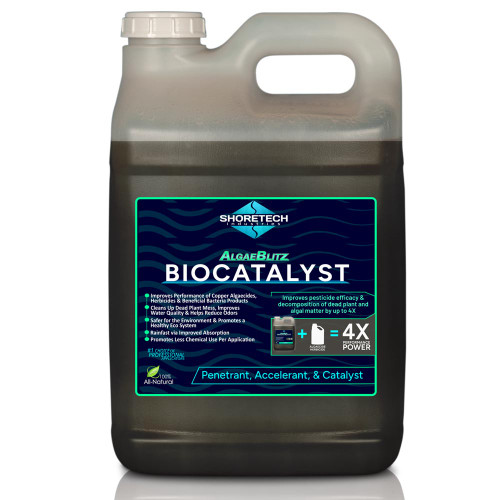
Biocatalyst
An all-natural adjuvant that improves algaecide and herbicide performance.
Why it fits: Can boost treatment efficiency; mix and apply according to both product labels.
Shop BiocatalystSpreader Attachment for Leaf Blower
Turns a leaf blower into a handheld spreader.
Why it fits: Helps spread granular treatments evenly.
Shop Spreader Attachment for Leaf BlowerMuck Reducer Tablets | Eradicator Plus
Probiotic tablets that digest decaying organic matter.
Why it fits: Helps break down dead vegetation after treatment; apply after the chemical treatment.
Shop Muck Reducer TabletsFAQs
Jettison Aquatic Herbicide + Algaecide FAQs
Answers about Jettison water-soluble packets, how they compare with Hydrothol 191, application and label restrictions. Always follow the complete product label.
Is Jettison a herbicide or an algaecide?
Both. Jettison is an aquatic herbicide and algaecide labeled for certain submerged aquatic weeds and algae in approved aquatic sites.
What is the difference between Jettison and Hydrothol 191?
Both use the endothall active-ingredient family. Jettison uses concentrated gel beads sealed inside pre-measured 5 oz. water-soluble packets, so for the drop application method you calculate whole packets instead of measuring an individual dose. They are different formulations and concentrations, so rates are not interchangeable.
Can Jettison replace Hydrothol 191 Granular?
Jettison can be a practical alternative for many labeled algae and submerged weed treatments where customers previously considered Hydrothol 191 Granular. It is not a 1:1 rate replacement. Always calculate the Jettison rate from the Jettison label and match it to the target species, site and water depth.
What if I searched “Hydrothol 191 granual”?
“Granual” is a common misspelling of granular. If you were looking for Hydrothol 191 Granular, Jettison is an alternative endothall formulation that uses pre-measured water-soluble packets instead of loose granular product.
How do I apply Jettison?
Determine the treatment area and average depth, select the labeled ppm rate for your target, and calculate the number of whole packets needed. Keep the packets sealed and toss or drop them evenly throughout the treatment area. The packets dissolve and release the gel beads into the water column. See the Application Instructions and Treatment Rates tabs.
What does Jettison control?
Planktonic, filamentous and branched algae such as Chara and Nitella, plus submerged weeds including Hydrilla, Milfoil, Coontail, Naiad, Elodea, Eelgrass, Fanwort and many pondweeds, according to the rates and regional restrictions on the label.
How many packets come in a package?
Each package contains four 5 oz. water-soluble packets.
Can I treat my whole pond at once?
No. Decomposing vegetation uses up dissolved oxygen and can harm fish. Do not treat more than one-third to one-half of the water body at one time. Start along the shoreline and work outward in bands, and do not exceed the maximum single application rate within a 7-day interval.
Where should I not use Jettison?
Do not use Jettison in waters containing Koi or hybrid goldfish, in small-volume garden ponds, or in brackish or salt water. Check with your state or local pesticide agency before treating public waters, as a permit may be required.
Is Jettison the same as Aquacide?
No. Aquacide is a separate product and brand. Jettison is specifically an endothall-based aquatic herbicide and algaecide packaged in water-soluble packets.
Related Products


Flumigard Herbicide | Aquatic Weed Control
