

Water Shield

Water Shield (Brasenia schreberi) is a perennial aquatic plant characterized by its oval, floating leaves with a distinctive gelatinous coating on the underside, and small, dull-purple flowers. It is commonly found in still or slow-moving freshwater bodies across North America, often forming dense mats that can impact water quality and recreational activities.
What is Water Shield (Brasenia schreberi)?
Water Shield, scientifically known as Brasenia schreberi, is a unique perennial aquatic plant belonging to the Cabombaceae family. It is easily recognized by its distinctive floating leaves and the thick, clear, jelly-like mucilage that covers its submerged parts, including the undersides of its leaves, stems, and buds. This mucilaginous coating is believed to protect the plant from herbivores and desiccation.
Native to North and South America, Africa, Asia, and Australia, Water Shield thrives in shallow, still, or slow-moving freshwater environments such as lakes, ponds, and quiet streams. It often forms dense colonies, creating extensive mats on the water's surface. While it contributes to the aquatic ecosystem by providing habitat and food for various organisms, its rapid growth can sometimes lead to overpopulation, impacting water quality, hindering recreational activities like boating and fishing, and outcompeting native vegetation.
Identifying Water Shield
Physical Characteristics
Leaves:
- Alternate
- Leaf stalks long
- Shield- or oval- shaped
- Floating
- Smooth on top
- Jello-like on bottom
- Up to 4 inches long
Flowers:
- Grow from the axil
- Small
- Dull-purple in color
- 3-4 petals and sepals each
- 0.39-0.59 inches long
- Anthers release pollen toward the inside of the flower
Fruit:
- Club-shaped
- Leather texture
- Does not split to release seeds when ripe
- 0.23-0.31 inches long
Stem:
- Slender
Roots:
- Slender
- Rooted in mud
Characteristics of Water Shield
Water Shield exhibits several distinct characteristics that aid in its identification and understanding of its ecological role:
Leaves
- Shape and Arrangement: The leaves are typically oval or elliptical, measuring up to 4 inches (10 cm) long. They are peltate, meaning the petiole (leaf stalk) attaches to the center of the leaf blade, giving them a shield-like appearance.
- Surface: The upper surface of the leaves is smooth, green, and often glossy, while the underside is typically reddish-purple.
- Mucilage: A defining feature is the thick, clear, jelly-like mucilaginous coating on the undersides of the leaves, stems, and buds. This protective layer feels slimy to the touch.
- Floating: The leaves float on the water's surface, supported by long, flexible petioles that extend from the submerged stem.
Flowers
- Appearance: Water Shield produces small, dull-purple to reddish-brown flowers that emerge above the water surface on slender stalks.
- Petals and Sepals: Each flower typically has 3-4 petals and 3-4 sepals, which are similar in appearance.
- Pollination: The flowers are protogynous, meaning the female reproductive parts mature before the male parts, promoting cross-pollination. They are wind-pollinated.
Stem and Roots
- Stem: The submerged stems are slender, branched, and can grow quite long, extending from the rooted rhizomes to the water surface.
- Roots: Water Shield is rooted in the mud at the bottom of the water body, with slender rhizomes that anchor the plant and allow for vegetative reproduction.
Fruit
- Structure: The fruit is a small, leathery, club-shaped berry that does not split open to release its seeds when ripe.
- Seeds: Each fruit contains 1-2 seeds.
Ecological Role and Habitat of Water Shield
Water Shield plays a multifaceted role in the aquatic ecosystems it inhabits, and its presence can indicate specific environmental conditions.
Habitat
- Preferred Environment: Water Shield thrives in still or slow-moving freshwater bodies. This includes the shallow margins of lakes, ponds, bogs, marshes, and quiet sections of rivers and streams.
- Water Depth: It typically grows in water depths ranging from a few inches to several feet, as long as its roots can reach the muddy substrate.
- Sediment: It prefers soft, mucky bottoms rich in organic matter, which provide ample nutrients for its growth.
- Light Conditions: As a floating-leaved plant, it requires access to sunlight at the water's surface for photosynthesis.
Ecological Significance
- Food Source: The leaves and seeds of Water Shield can serve as a food source for various waterfowl, muskrats, and other aquatic animals.
- Habitat and Shelter: Dense mats of Water Shield provide shelter and breeding grounds for fish, amphibians, and aquatic invertebrates, protecting them from predators and strong currents.
- Water Quality: Like other aquatic plants, Water Shield contributes to oxygenation of the water during photosynthesis and can absorb excess nutrients, potentially reducing algal blooms. However, excessive growth can also lead to oxygen depletion when the plants decompose.
- Sediment Stabilization: Its root systems help to stabilize bottom sediments, reducing erosion and improving water clarity.
Potential Issues with Overgrowth
While beneficial in moderation, extensive growth of Water Shield can lead to several problems:
- Reduced Biodiversity: Dense mats can shade out submerged native vegetation, reducing plant diversity.
- Recreational Impairment: Thick growth can interfere with swimming, boating, fishing, and other recreational activities.
- Oxygen Depletion: Large quantities of decaying plant matter can deplete oxygen levels in the water, especially at night or during decomposition, potentially harming fish and other aquatic life.
- Mosquito Breeding: The still water trapped within dense mats can create ideal breeding grounds for mosquitoes.
Controlling Water Shield In Lakes And Ponds
Physical Management of Water Shield
Water Shield has a root system which means the roots need to be destroyed to prevent the plant from coming back.
Products To Physically Manage Water Shield

Our WeedShear measures 49 inches in width and features a v-shaped razor sharp stainless steel blades that easily cuts through Water Shield at its roots. This product comes with a hand held sharpener, a 25 foot polypropylene rope and folds up for easy storage.
To use the WeedShear, simply give it a toss out into your lake or pond and let it sink to the bottom. Once it hits the bottom, simply use a jerking motion to drag the WeedShear along the bottom of the lake or pond.
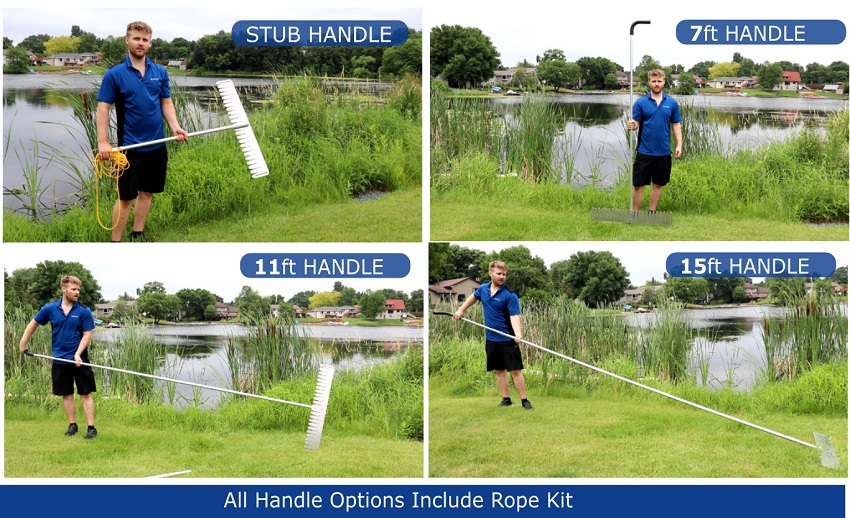
The Weed Ripper is designed to pull Water Shield by the roots to prevent it from growing back.
The Weed Ripper features a 3 foot wide head and comes with a 25 foot rope that allows you to cut and pull weeds by tossing it into your lake or pond and pulling it back to you. Additionally, the Weed Ripper comes with 4, 7, 11 and 15 foot handle options.
 - Aquatic Vegetation Groomer (AVG)
The AVG is a gas powered underwater aquatic weed cutter that was especially designed to cut down Water Shield at its root base. It uses two circular reciprocating blades which prevents it from getting tangled up like other weed whacker products sold online.
The AVG can be used in water depths up to 4 feet and comes with a 2 year warranty. It has a powerful 24 cc 2-cycle engine and a sealed gear box to keep it running smooth for years to come. Additionally, we have an optional shoulder strap and an optional float mount available to make the job of cutting down Water Shield that much easier.
Automated Control of Water Lily
For homeowners, automated control of Water Shield is ideal when your lake bottom has been cleared and you want to keep it that way without having to continuously labor away cutting weeds.
For lake and pond management companies, automated control of Water Shield is ideal when you have a large lake or pond that has been overtaken by the weed.
Automated Products To Control Water Shield

Our Lake Groomer is for homeowners who want to maintain a muck free lake bottom. The Lake Groomer uses a rolling action along the bottom of your lake or pond and dislodges any existing Water Shield and prevents it from growing.
The Lake Groomer comes standard with three – 7 feet roller tubes that can cover a total of 21 feet of lake bottom and comes with a 3 year warranty.

The Aquatic Mower is an electric powered aquatic weed cutter that mounts to your boat and works very efficiently to cut down Water Shield fast. If you are looking for an environment friendly, non-labor intensive solution to riding your lake or pond from Water Shield than the Aquatic Mower is what you have been looking for.
The Aquatic Mower weighs just 45 pounds and has a 12 volt DC electric motor that has a batter life of up to 6 hours. It is made of rust resistant aluminum and stainless steel and has a cutting width of 4 feet.
For lake and pond management companies, our Eco Harvester pulls Water Shield up from the roots and harvests them to be reused as mulch or animal feed.
The Eco Harvester can operate in as little as 12 inches of water and is built so it only takes one person to operate. Additionally, our patent protected Eco Harvester is one-third the price of traditional harvesters, making it one of the most affordable Water Shield removal machines on the market.
Herbicide Control of Water Shield
Herbicide control is a great option for Water Shield because you can literally apply the herbicide and then sit back and let it do its work. Most herbicides can control Water Shield throughout the season and only needs to be applied once a year.
Navigate Granular is formulated on special heat treated attaclay granules that resist rapid decomposition in water. They quickly sink to your lake or pond bottom and release 2,4-D into the critical root zone.
Initial effects are indicated by brittle stems and curling leaf tips and are noticeable within 7 to 10 days. A full kill will occur within 3 to 5 weeks.