

Liquid Bacteria Pond Enzyme Water Clarifier





Description
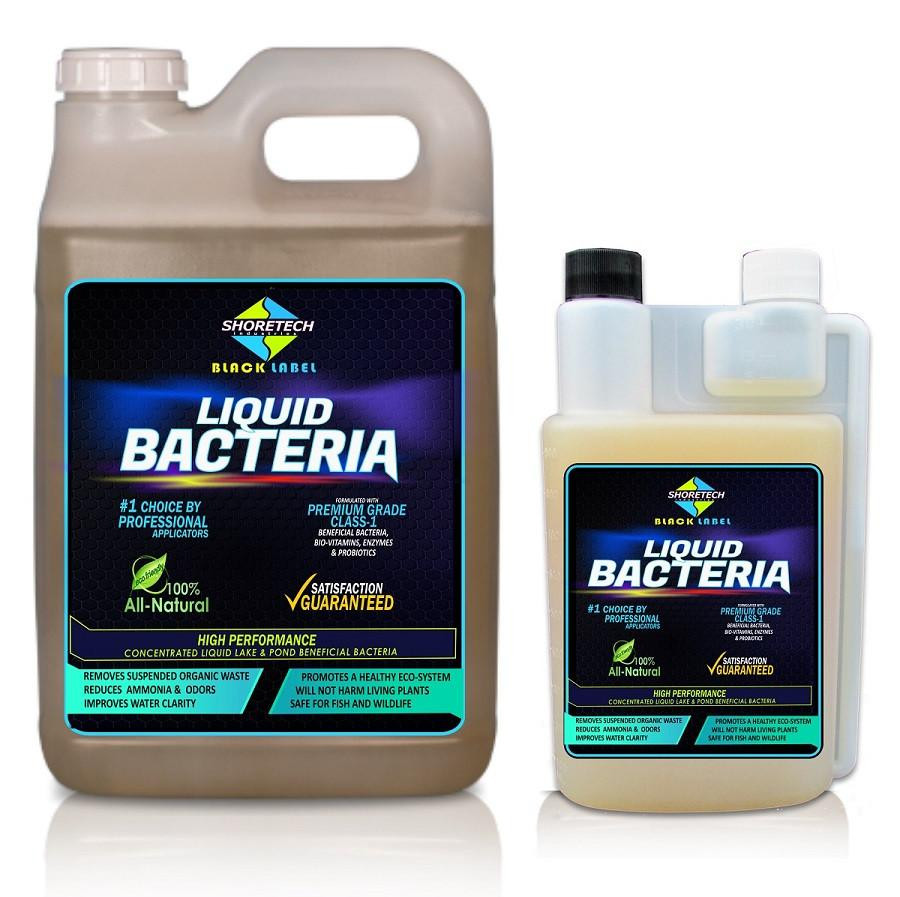
Liquid Beneficial Bacteria Pond Enzyme Water Clarifier
Support clearer, healthier-looking pond water with Black Label Liquid Beneficial Bacteria, a concentrated biological treatment containing 12 different beneficial bacteria formulated to help break down decaying organic matter in lakes and ponds.
If you’re looking for pond enzymes, liquid bacteria, or pond bacteria and enzymes to help manage organic buildup, Black Label offers a convenient liquid microbial treatment that supports natural decomposition and water quality management. As aquatic weeds, algae, leaves and other organic materials decompose, they can contribute to murky water, unpleasant odors, nutrients and accumulated organic sludge.
Beneficial bacteria naturally produce enzymes as part of their biological processes. However, the product’s published specifications identify the bacterial blend rather than a separately measured enzyme concentration. Unlike mechanical muck-removal equipment, the formula works through biological activity rather than physically excavating sludge.
The recommended dosage is 20 fluid ounces per acre-foot of water, applied once per month. At that rate, one gallon is advertised to treat approximately 6 acre-feet of water, or nearly 2 million gallons, for one monthly application. For best biological activity, apply when water temperatures reach 60°F (15.6°C) or warmer. Choose from 32 oz or 1-gallon containers using the product options.
- 12 beneficial bacteria
- Liquid pond clarifier
- 20 fl oz per acre-foot, monthly
- 32 oz & 1 gallon sizes
- Best at 60°F+

How Pond Bacteria & Enzymes Support Water Quality
Introduce Liquid Microbes
Add a concentrated blend of microorganisms to supplement natural biological activity in suitable lake and pond conditions.
Break Down Organic Waste
Beneficial bacteria use biological processes, including enzyme activity, to help digest appropriate biodegradable material.
Support Better Water Clarity
Regular treatments help support organic matter decomposition and natural nutrient cycling.
Why Choose Black Label Liquid Beneficial Bacteria?
12-Strain Bacterial Blend
A proprietary blend of 12 bacteria formulated for biological water treatment.
Highly Concentrated Formula
The published dose is 20 fl oz per acre-foot per month.
Supports Organic Breakdown
Helps process decomposing aquatic plants, biodegradable debris and organic residues.
Water Column Treatment
The liquid format is intended for distribution throughout suitable pond and lake water.
Beneficial Microbial Activity
Introduces liquid microbes involved in organic decomposition and nutrient cycling.
Monthly Maintenance
The same recommended rate for initial and monthly applications.
Two Convenient Sizes
Available in a 32 oz bottle and 1-gallon container.
Complements Other Treatments
Part of a broader program with bottom-targeted muck bacteria, aeration or other appropriate treatments.
Black Label is documented as a 12-bacteria liquid formula. Although beneficial microorganisms can produce enzymes, a separate enzyme assay or guaranteed enzyme activity rating has not been published.
How Much Water Does Black Label Treat?
Acre-feet measure pond water volume, not surface acreage alone. Calculate the dose using the waterbody’s surface area and average depth.
32 oz Bottle · ~1.6 Acre-Feet
At 20 fluid ounces per acre-foot, the 32 oz bottle provides approximately 1.6 acre-feet of one monthly treatment.
1 Gallon · ~6 Acre-Feet
The gallon container is advertised to treat approximately 6 acre-feet, or nearly 2 million gallons, for one monthly treatment.
Liquid Bacteria vs. Algae & Weed Treatments
Black Label is a biological pond treatment. It does not work the same way as an aquatic herbicide, algaecide, flocculant or physical muck-removal system. It supports decomposition of suitable organic matter; it is not intended to kill healthy rooted plants, eliminate active algae blooms immediately, or excavate bottom sediment.
Biological bacterial treatments support decomposition. Flocculants aggregate suspended particles. Algaecides control algae when used according to their labels. Where accumulated bottom muck is the primary concern, bottom-targeted muck digester pellets may be more appropriate; if water stays cloudy from suspended mineral clay, a different clarification approach may be needed.
Large quantities of decomposing organic matter can consume dissolved oxygen. Monitor water quality and fish health, particularly when substantial algae or aquatic vegetation is dying.
Need Help Choosing Pond Bacteria or Enzymes?
Tell us your pond’s surface area, average depth, water temperature and primary problem. Our team can help you compare liquid bacteria, powder clarifiers, muck pellets, cold-water bacteria and other appropriate solutions.
Call Weeders Digest: 877-224-4899.
Features
Black Label Liquid Bacteria & Pond Enzyme Treatment Features
A concentrated, warm-water biological treatment.
12 Beneficial Bacteria
A proprietary blend of 12 different bacteria formulated for water treatment.
Concentrated Liquid Formula
20 fluid ounces per acre-foot for the recommended monthly treatment.
Water Clarity Support
Supports biological processing of organic matter associated with murky water.
Organic Matter Digestion
Supports decomposition of biodegradable vegetation and organic debris.
Natural Microbial Activity
Bacteria participate in nutrient cycling and can produce enzymes as part of their metabolism.
Water Column Application
Intended for distribution through suitable water areas.
Monthly Maintenance
The initial and maintenance rates are the same.
Two Container Sizes
32 oz or 1 gallon to match the desired treatment volume.
Warm-Water Activity
Recommended operating temperature of at least 60°F.
Compatible Management Approach
Complements aeration, water management and bottom muck treatment programs.
Liquid Beneficial Microbes
A convenient liquid format for introducing beneficial bacteria.
Multiple Pond Applications
Lakes, ponds, canals, decorative water features, retention ponds and other managed waterbodies.
How It Works
How Liquid Bacteria & Pond Enzymes Work
Beneficial bacteria are naturally present in aquatic ecosystems and help process organic matter. Bacteria can produce enzymes that break complex organic compounds into substances microorganisms can use. Black Label supplies a proprietary 12-bacteria blend to support these processes.
-
Apply the Bacteria
Measure the recommended dose and apply it to the intended treatment area.
-
Distribute Through the Water
The liquid disperses according to the application method and local water movement.
-
Support Organic Decomposition
Beneficial bacteria help process suitable biodegradable material when conditions support microbial activity.
-
Participate in Nutrient Cycling
Microbial activity contributes to nutrient uptake and transformation.
-
Repeat the Monthly Treatment
Apply the recommended monthly dose while monitoring pond conditions.
What Is the Difference Between Bacteria and Enzymes?
Bacteria are living microorganisms that can grow and participate in decomposition. Enzymes are biological catalysts that assist chemical reactions, including the breakdown of organic compounds.
A pond enzyme product may contain added enzymes, bacteria or both. Black Label is specifically documented as containing 12 bacteria; a separate guaranteed enzyme concentration has not been established.
Microbial nutrient uptake and transformation do not guarantee permanent removal of phosphorus or nitrogen. A complete program may also need to address runoff, sediment and external nutrient sources.
Sizes & Coverage
32 oz vs. 1 Gallon Liquid Beneficial Bacteria
Two sizes for different treatment volumes.
| 32 oz Bottle | 32 US fluid ounces · approx. 1.6 acre-feet · smaller ponds and treatment areas |
|---|---|
| 1 Gallon | 128 US fluid ounces · approx. 6 acre-feet as advertised · larger ponds and repeated applications |
Understanding Acre-Feet
One acre-foot is the volume of water covering one acre to an average depth of one foot, approximately 325,851 gallons. Formula: Surface Acres × Average Depth (ft) = Acre-Feet. Example: a half-acre pond averaging four feet deep contains approximately two acre-feet.
Why Average Depth Matters
Ponds with identical surface areas can contain very different volumes. A one-acre pond averaging two feet deep contains two acre-feet; one averaging six feet deep contains six acre-feet.
Using the deepest point instead of average depth can substantially overestimate the pond’s water volume.
Dosage & Coverage Chart
Liquid Pond Bacteria Dosage & Monthly Treatment Chart
Initial and maintenance application: 20 fluid ounces per acre-foot, applied once per month according to the product directions.
| 0.25 acre-foot | ~81,500 gallons · 5 fl oz |
|---|---|
| 0.5 acre-foot | ~163,000 gallons · 10 fl oz |
| 1 acre-foot | ~326,000 gallons · 20 fl oz |
| 1.5 acre-feet | ~489,000 gallons · 30 fl oz |
| 2 acre-feet | ~652,000 gallons · 40 fl oz |
| 3 acre-feet | ~978,000 gallons · 60 fl oz |
| 4 acre-feet | ~1,303,000 gallons · 80 fl oz |
| 6 acre-feet | ~1,955,000 gallons · 120 fl oz |
Water volumes are rounded, using approximately 325,851 gallons per acre-foot. Monthly amount: Surface Acres × Average Depth (ft) × 20 = fluid ounces per month.
Example: Half-Acre Pond With a Four-Foot Average Depth
- Surface area: 0.5 acre
- Average depth: 4 feet
- Volume: 0.5 × 4 = 2 acre-feet
- Monthly dose: 2 × 20 = 40 fl oz
A 128 fl oz gallon mathematically provides 6.4 acre-feet at the listed rate. The published coverage is rounded to approximately 6 acre-feet.
Calculate the amount using your pond’s estimated water volume and follow the product instructions.
Application Instructions
How to Apply Liquid Beneficial Bacteria to a Pond
Use the directions supplied with the container. These steps explain the general process.
-
Calculate Pond Volume
Multiply surface acreage by average depth to find acre-feet.
-
Measure the Monthly Dose
Use 20 fl oz per acre-foot.
-
Check Water Temperature
Recommended for water temperatures of 60°F or warmer.
-
Identify the Treatment Area
Evaluate areas affected by decomposing vegetation, suspended organic material or reduced clarity.
-
Apply and Distribute
Apply the measured treatment per the directions and distribute it through the intended water area where appropriate.
-
Monitor Water Conditions
Observe clarity, organic debris, odors and any signs of aquatic life stress.
-
Repeat Monthly
Follow the recurring treatment schedule during suitable conditions.
Can Liquid Bacteria Be Applied With a Sprayer?
Liquid biological treatments may be applied through suitable aquatic treatment equipment when permitted by the product directions. Use clean equipment and confirm that the method, any dilution and previous tank contents are compatible.
Do not assume that bacteria, disinfectants, herbicides, algaecides or other pond chemicals can be combined in one tank.
Where to Use
Where Can You Use Liquid Pond Bacteria?
Listed applications for Black Label.
Decorative Ponds
Organic matter management in ornamental water features.
Koi Ponds
A supplementary biological treatment when appropriate for the fish and filtration.
Residential Ponds
Address biodegradable residue and nutrient-related water quality concerns.
Lakes
Suitable lake treatment areas where biological organic matter management is desired.
Golf Course Ponds
Appropriate landscape pond maintenance programs.
Retention Ponds
Support decomposition in suitable stormwater and retention systems.
Canals
Where water conditions, flow and local requirements permit.
Aquaculture & Hatcheries
Listed applications; verify compatibility with species and facility requirements.
Aquaculture facilities, hatcheries, public waters and flowing systems may have additional requirements affecting product suitability.
What It Targets
What Can Pond Bacteria & Enzymes Help Address?
How biological bacteria help, and their limits.
| Decaying Aquatic Weeds | Support decomposition of dead biodegradable plant material · does not directly kill living rooted weeds |
|---|---|
| Suspended Organic Debris | Support biological processing in the water column · may not address mineral clay or silt |
| Organic Pond Odors | May help address organic loading associated with odors · will not eliminate every odor source |
| Organic Sludge | Can complement management of biodegradable organic material · thick bottom muck may need pellets or removal |
| Excess Nutrients | Support microbial nutrient uptake and cycling · no guaranteed permanent nutrient removal |
| Cloudy Pond Water | May improve clarity when biodegradable organic matter contributes · different causes need different treatments |
| Active Algae Blooms | Can support a broader nutrient-management program · not an algaecide |
| Heavy Clay and Sand | Not the primary application · may require a different clarification method |
Should You Choose a Clarifier or Flocculant?
It depends on what is making the pond cloudy. A biological clarifier uses microorganisms to support the breakdown of biodegradable organic matter. A flocculant aggregates certain suspended particles so they can separate from the water. If your pond has suspended clay or mineral particles, liquid bacteria may not address the primary cause; if decaying vegetation and organic residues are the concern, a biological treatment may be more relevant.
Green water from algae, brown water from organic compounds, and cloudy water from suspended clay can require different approaches.
After Algae & Weed Treatment
Using Liquid Bacteria After Weed or Algae Treatments
When aquatic plants or algae die, their tissues decompose and add organic matter to the water. Black Label is marketed as a complementary biological treatment for processing degraded vegetation after a weed or algae control project.
-
Identify the Primary Problem
Determine whether the issue involves living weeds, active algae, decomposing vegetation or bottom muck.
-
Remove Excess Vegetation
Collect large mats of dead or detached vegetation where practical.
-
Support Biological Breakdown
Use an appropriate biological treatment program when permitted by the product directions.
-
Address Bottom Muck
Consider targeted muck digester pellets when organic sludge is accumulating on the bottom.
-
Maintain Pond Conditions
Monitor dissolved oxygen, nutrient inputs, circulation and recurring seasonal problems.
Liquid Bacteria + Biocatalyst
Biocatalyst is promoted to support breakdown of dead aquatic vegetation and algae, and Black Label Liquid Bacteria is marketed as a complementary product for processing remaining organic material. Explore the Biocatalyst + Liquid Bacteria Bac-Pac for the paired product option.
Large algae or weed die-offs can reduce dissolved oxygen and stress or kill fish. Follow applicable pesticide labels and do not assume biological products eliminate oxygen-depletion risks.
Temperature & Timing
Warm-Water Liquid Bacteria vs. Cold Water Bacteria for Ponds
Black Label is recommended when water temperatures are 60°F (15.6°C) or higher. In colder conditions, biological decomposition often slows.
60°F and Above
Preferred treatment conditions: use the published monthly rate when temperature and other conditions are appropriate.
Below 60°F
Expect many microorganisms to slow as water temperature declines.
Cold-Water Alternative
Compare a formulation intended for cooler conditions, such as PolarZyme.
When Should I Apply Black Label?
The published schedule recommends 20 fl oz per acre-foot for both the initial and monthly maintenance treatments. Monitor water temperature and conditions throughout the season.
Are Cold Water Bacteria for Ponds Better in Fall?
A cold-water-specific formula may be more appropriate when temperatures fall below this product’s recommended range. Weeders Digest offers PolarZyme Cold Water Pond Clarifier for colder treatment conditions.
The published rate does not establish a higher application amount for lower temperatures.
Bacteria Comparison
Liquid Bacteria vs. Powder, Pellet & Pond Enzyme Products
Treatment formats suit different water-quality objectives.
| Liquid Bacteria | Applied to pond water · organic matter and biological clarification in the water column · clarity concerns involving biodegradable material |
|---|---|
| Powder Bacteria | Dry powder or dissolvable packets · general biological treatment · customers preferring dry or premeasured applications |
| Muck Digester Pellets | Distributed over target bottom areas · organic material on the bottom · shoreline muck and sludge deposits |
| Bacterial Pucks or Blocks | Placed as directed · localized or continuing treatment · users preferring solid formats |
| Standalone Pond Enzymes | Depends on formulation · enzyme-mediated breakdown of specific compounds · where an appropriate enzyme formula is identified |
| Flocculants | Product-specific directions · aggregation of certain suspended particles · turbidity not primarily caused by biodegradable matter |
| Aeration Systems | Installed in ponds or lakes · oxygenation and circulation · waterbodies needing oxygen or water movement |
When to Choose Liquid Bacteria
When you want a concentrated bacterial treatment directed toward decomposing organic material and related biological water management.
When to Choose Muck Pellets
When heavy organic muck has accumulated at the lake or pond bottom.
When to Choose a Flocculant
For specific suspended-particle problems; not a substitute for every biological or nutrient treatment.
Read the Weeders Digest guide to lake and pond bacteria: pellets vs. powder vs. liquid.
Pond Management Tips
Tips for Better Results With Pond Bacteria & Enzymes
Microbial treatments are one part of a complete water-quality strategy.
Reduce Nutrient Runoff
Limit avoidable fertilizer runoff and other nutrient inputs.
Remove Large Weed Piles
Collect heavy mats of dead vegetation instead of letting them decay in the water.
Monitor Temperature
Apply Black Label during appropriate warm-water conditions.
Evaluate Aeration
Consider oxygen and circulation needs, particularly where substantial decomposition occurs.
Target Bottom Muck
Use bottom-focused treatments when thick organic deposits accumulate.
Track Water Quality
Record clarity, temperatures, treatment dates, odors and seasonal changes.
Biological clarification will not solve every cloudy-water problem. Suspended clay, active algae or runoff-related turbidity may require a different plan.
Care & Storage
Liquid Beneficial Bacteria Storage & Handling
Because Black Label is a biological formulation, proper handling and storage are important.
- Follow the container label. Use the supplied storage and handling directions.
- Keep the lid securely closed. Prevent spills and contamination.
- Avoid excessive heat. Do not leave containers in hot vehicles or prolonged direct sunlight.
- Protect from freezing. Follow the manufacturer’s cold storage instructions.
- Use clean measuring tools. Avoid contaminating the original container.
- Store away from children. Keep pond treatment products securely stored.
- Keep away from incompatible chemicals. Avoid accidental mixing with disinfectants and other treatments.
- Check product condition. Follow manufacturer guidance for unusual appearance, damage or expired product.
A specific shelf life, storage-temperature range and freeze-thaw tolerance have not been established in the published specifications.
Safety & Compatibility
Beneficial Pond Bacteria: Safety & Responsible Use
Black Label is marketed as an all-natural biological pond treatment for appropriate freshwater environments. Follow the supplied directions and evaluate the waterbody before applying.
Fish & Aquatic Life
Monitor dissolved oxygen and water quality, especially during substantial decomposition.
People & Pets
Follow product safety directions and water-use guidance. Do not ingest the concentrate.
Aquatic Plants
Not intended to kill living rooted aquatic vegetation.
Aquaculture Facilities
Confirm compatibility with the species, filtration and operating requirements.
Other Water Treatments
Check compatibility before combining with algaecides, herbicides or other pond chemicals.
Water Quality Monitoring
Observe oxygen and other parameters when significant organic material is decomposing.
Heavy biological decomposition can consume dissolved oxygen. Severe fish stress or sudden water-quality changes require prompt evaluation.
Treatment of public waters, drinking-water reservoirs, aquaculture systems and managed stormwater facilities may be subject to additional rules.
Specifications
Black Label Liquid Bacteria Pond Enzyme Water Clarifier Specifications
Full product specifications.
| Product Name | Liquid Bacteria Pond Enzyme Water Clarifier |
|---|---|
| Formula Name | Black Label Liquid Beneficial Bacteria |
| Product Category | Biological lake and pond water treatment |
| Product Form | Liquid concentrate |
| Beneficial Bacteria | Proprietary blend of 12 different bacteria |
| Individual Bacteria Species | Not specified in the published product information |
| Guaranteed CFU Count | Not published |
| Enzyme Activity Rating | No separately measured enzyme assay or guaranteed enzyme concentration published |
| Available Sizes | 32 fl oz and 1 US gallon |
| Initial Treatment Rate | 20 fl oz per acre-foot |
| Maintenance Treatment Rate | 20 fl oz per acre-foot monthly |
| Application Frequency | Once per month |
| Preferred Water Temperature | 60°F / 15.6°C or warmer |
| 1 Gallon Published Coverage | Approximately 6 acre-feet / roughly 2 million gallons |
| 32 oz Calculated Coverage | Approximately 1.6 acre-feet |
| Primary Treatment Zone | Water column and suitable near-surface areas |
| Primary Biological Focus | Organic matter decomposition and nutrient cycling |
| Potential Benefits | Water clarity support, digestion of degraded vegetation, and biological water-quality management |
| Typical Applications | Lakes, ponds, decorative water features, retention ponds, golf course ponds, canals and appropriate aquaculture systems |
| Living Weed Killer? | No |
| Algaecide? | No |
| Flocculant? | Not identified as a flocculant |
| Mechanical Muck Removal? | No |
| Related Treatments | Biocatalyst, muck digester pellets, suitable aeration and other water-quality products |
| Exact Shelf Life | Not specified |
| Storage Temperature Range | Not specified |
| Warranty | Confirm applicable guarantee or warranty terms with Weeders Digest |
Related Tools
Related Pond Bacteria, Enzymes & Water Clarifiers
Liquid bacteria supports water-column organic matter processing; muck pellets target bottom deposits; cold-water formulations suit different temperatures; and phosphorus binders address separate nutrient goals.
FAQs
Liquid Bacteria, Pond Enzymes & Water Clarifier FAQs
Answers about bacteria, enzymes, dosage, uses and storage.
What is Black Label Liquid Beneficial Bacteria?
A concentrated biological pond treatment containing a proprietary blend of 12 different bacteria formulated to support organic matter decomposition and water clarity.
What are pond enzymes?
Biological catalysts involved in the breakdown of certain organic materials. Some treatments contain added enzymes, beneficial bacteria or both. Check each formula’s ingredients and activity specifications.
Is Black Label a pond enzyme treatment?
It is marketed as a pond bacteria and enzyme water clarifier. Its documented formulation is a blend of 12 bacteria, without a separately published enzyme concentration or activity measurement.
What is the difference between pond bacteria and enzymes?
Bacteria are living microorganisms that participate in decomposition. Enzymes are biological catalysts that assist specific reactions. Bacteria may produce enzymes during their activity.
Do pond bacteria and enzymes remove muck?
They can support decomposition of suitable biodegradable material. Heavy bottom muck may also require targeted pellets, physical removal or other methods.
What is liquid bacteria for ponds?
A biological water treatment containing beneficial microorganisms intended to support organic matter breakdown and other microbial processes.
What does liquid beneficial bacteria do?
It supplements microbial activity that processes biodegradable organic material and participates in nutrient cycling.
Is bacteria liquid the same as liquid beneficial bacteria?
Customers searching for “bacteria liquid” generally mean a liquid formulation of beneficial microorganisms for pond water. Black Label is such a treatment, though its formulation and dosage are specific to this product.
What is a bacterial liquid water clarifier?
A liquid beneficial bacteria treatment intended to support the biological processing of organic matter associated with cloudy water.
What are liquid microbes?
Microorganisms supplied in a liquid formulation. Black Label contains a blend of 12 different bacteria.
Does this pond enzyme clarifier contain 12 bacteria?
Yes. The product information identifies a proprietary blend of 12 different bacteria.
What bacteria species does the formula contain?
The individual species are not listed in the available specifications. Contact Weeders Digest if you require detailed organism information.
Is this a clarifier or flocculant?
A biological clarifier containing beneficial bacteria. It is not identified as a chemical flocculant.
What is the difference between a pond clarifier and a flocculant?
A biological clarifier supports microbial decomposition, while a flocculant helps aggregate certain suspended particles for separation.
Are cold water bacteria for ponds better than this formula?
A cold-water formula may be more appropriate below Black Label’s preferred 60°F range. PolarZyme is an available alternative for cooler conditions.
How many strains of bacteria does Black Label contain?
12 different bacteria in its proprietary blend.
What is the Black Label liquid bacteria dosage?
20 fl oz per acre-foot of water once per month.
What is the maintenance dosage?
The same as the initial dose: 20 fl oz per acre-foot monthly.
How often should I add liquid bacteria to my pond?
Once per month.
How much water does one gallon treat?
Approximately 6 acre-feet, or nearly 2 million gallons, for one monthly treatment.
How much water does a 32 oz bottle treat?
Approximately 1.6 acre-feet for one monthly treatment.
What is an acre-foot of water?
The water covering one acre to an average depth of one foot, approximately 325,851 gallons.
How do I calculate how much product my pond needs?
Multiply surface area in acres by average depth in feet to find acre-feet, then multiply by 20 for the monthly amount in fluid ounces.
How much bacteria do I need for a half-acre pond?
It depends on average depth. A half-acre pond averaging 4 feet deep contains 2 acre-feet and requires 40 fl oz per monthly treatment.
What water temperature is best?
60°F or warmer.
Will liquid beneficial bacteria work in cold water?
Bacterial activity may slow in colder conditions. Compare a product formulated for lower temperatures.
Should I use more bacteria in cold water?
The directions do not specify a higher cold-water dose. Follow the stated rate.
How quickly will pond bacteria improve water clarity?
Results vary with temperature, organic loading, oxygen, circulation, nutrients and the cause of the cloudiness. Biological clarification is not instant.
Will this product make every pond crystal clear?
No. Suspended clay, active algae, runoff and other causes of turbidity may require different treatments.
Does liquid bacteria remove pond sludge?
It supports biological processes involving organic material, primarily in the water column. Bottom-focused pellets may be more appropriate for substantial accumulated muck.
Can it help reduce lake-bottom muck?
It may complement a muck management program, but it is not a substitute for bottom-targeted treatments or physical sediment removal.
Does liquid pond bacteria remove unpleasant odors?
It may help with odors associated with decomposing organic matter, but will not necessarily resolve every odor source.
Does bacteria remove nitrogen and phosphorus?
Bacteria participate in nutrient uptake and cycling. Permanent removal from an entire waterbody is not guaranteed.
Can pond bacteria and enzymes help prevent algae?
They may support an overall nutrient management program, but do not guarantee algae prevention and are not an algaecide.
Will Black Label kill existing algae?
No. It is a biological treatment, not a product intended to kill living algae directly.
Does it kill aquatic weeds?
No. It supports decomposition of suitable dead plant material, not living rooted plants.
Can I apply it after aquatic weed treatment?
Yes. Black Label is marketed as a complementary treatment for degraded vegetation after weed control. Follow the instructions and compatibility requirements of all products used.
Can I combine it with Biocatalyst?
They are promoted as complementary components of an organic matter program. Follow their individual instructions and verify tank-mix compatibility.
What is the Black Label Bac-Pac?
A combination package containing Black Label Liquid Bacteria and Biocatalyst.
Can I use liquid bacteria with muck pellets?
Yes, for complementary purposes: liquid bacteria for the water column, pellets for bottom organic matter.
Can I use the product with an aerator?
Aeration supports oxygen and circulation. The benefit of combining it with bacteria depends on the pond and system.
Is liquid bacteria better than powdered pond bacteria?
Not universally. Compare formulations, dosage rates, application methods and the intended treatment zone.
Is liquid bacteria better than muck pellets?
It depends on the problem. Liquids target the water column, while muck pellets target accumulated bottom organic material.
Can I use Black Label in a decorative garden pond?
Decorative ponds are a listed application. Measure water volume and follow the directions.
Is the formula suitable for koi ponds?
Koi ponds are listed. Confirm compatibility with the pond’s filtration, livestock and water-management requirements.
Can I use it in a golf course pond?
Yes. Nutrient runoff and site conditions should also be evaluated.
Can it be used in retention ponds?
Retention ponds are listed. Verify suitability, water exchange and applicable rules.
Can I use liquid bacteria in canals?
Canals are listed. Moving water may influence distribution and retention.
Is Black Label suitable for aquaculture?
Aquaculture and hatchery applications are listed. Confirm suitability for the species, facility, filtration and water-quality requirements.
Is Black Label safe for fish?
It is marketed for aquatic environments. Follow directions and monitor oxygen, particularly during heavy decomposition.
Is it safe for people and pets?
Follow the supplied safety information. Do not assume the concentrate is suitable for ingestion or unrestricted direct contact.
Does liquid bacteria work in the water column?
Yes. Water-column treatment is a primary purpose of the liquid formulation.
Does beneficial bacteria work better with oxygen?
Oxygen availability affects many microbial decomposition processes. Aeration needs depend on the waterbody.
Can I apply liquid bacteria using a spray tank?
Use suitable equipment per the directions. Make sure the tank is clean and free of incompatible chemical residues.
Can I mix it directly with an algaecide?
Do not assume tank-mix compatibility. Check the algaecide label and biological treatment instructions first.
Do I need to treat the entire pond?
The rate is based on water volume. Determine the intended treatment area and its volume, then follow the directions.
Can I spot-treat the shoreline?
A targeted program may be appropriate in some conditions. Contact Weeders Digest for guidance.
Can I use it in a pond with a fountain?
Yes, when the formula is appropriate. A fountain may affect distribution but does not replace proper dosing or every aeration need.
Can rain affect pond bacteria treatments?
Rainfall and runoff change water volume, nutrient inputs and conditions. Follow the directions and monitor the pond.
Does it treat green pond water?
If the green color is caused by living planktonic algae, bacteria may be part of a broader program, but it is not an immediate algae-killing treatment.
Will liquid bacteria remove suspended clay?
It is not intended primarily for mineral clay or silt turbidity.
Is there a guaranteed nutrient-removal percentage?
No independently verified nitrogen or phosphorus removal percentage is published.
What is the guaranteed CFU count?
A guaranteed colony-forming-unit count is not provided in the available description.
Does Black Label list enzyme units or activity?
No separate enzyme assay or guaranteed enzyme activity rating is provided.
How should I store liquid beneficial bacteria?
Follow the container’s storage directions. Keep it closed and protect it from excessive heat and contamination.
Can the product freeze during storage?
Freeze-thaw tolerance is not published. Follow the supplied instructions and contact Weeders Digest if the product has frozen.
What is the shelf life?
A specific shelf life is not established. Check the container or contact Weeders Digest.
Do I need monthly treatments indefinitely?
The published maintenance schedule is monthly. Duration depends on pond conditions and goals.
Can liquid bacteria replace aquatic weed removal?
No. It does not physically remove living weeds or cut rooted plants.
How does bacteria compare with dredging?
Biological treatment works gradually on organic matter. Dredging physically removes sediment and may be appropriate for substantial material or depth restoration.
Where can I buy cold-water pond bacteria?
Explore PolarZyme Cold Water Pond Clarifier.
Where can I find bacteria for bottom muck?
Explore Shore Tech Muck Reducer Pellets for bottom-targeted organic muck treatment.
Does Weeders Digest sell other pond bacteria products?
Yes: liquid bacteria, powder bacteria, cold-water formulas, muck digester pellets and other biological water treatments.
Where can I compare pellet, powder and liquid bacteria?
Who can help calculate my pond bacteria dosage?
Call Weeders Digest at 877-224-4899 with your surface area, average depth, water temperature and primary concern.
Related Products


